
“Buy Me a Rocket” is a story which doesn’t exist and which was never written by Alfred Bester.
Captive Market
is a story by Philip K. Dick. It was first published in the April 1955 issue of a science fiction magazine called If and has since been reprinted many times, appearing in a number of collections of Dick’s short fiction. My first encounter with the story was in the pages of the fourth book of a five-volume series published by Gollancz. That paperback takes its title from another longer and better-known story included therein, the one adapted by Steven Spielberg into the 2002 film of the same name starring Tom Cruise.
Perhaps you’ve read Captive Market
. More than likely, you have not. Here’s a précis, in my own words and replete with spoilers — though I won’t give away the ending. For this post, I’ve just now re-reread the story and enjoyed it all over again and am full of enthusiasm. Hopefully, you will excuse my long-windedness. If you’d rather not read my summary and just want to get to the point of this post, then you’re welcome to skip over the next few paragraphs (the ones bounded in yellow).
A group of twenty survivors of an apocalyptic U.S.-Soviet conflict in which nuclear and biological weapons were intensively used are barely hanging on in a camp of shacks built from debris roughty forty miles east of San Francisco, in what is now Mount Diablo State Park. San Francisco was completely been obliterated in the Big Blast
, along with pretty much everything else. Flying insects survive to pester these last remnants of humanity, but seemingly not much else in the way of animal life. One character observes to himself that he hasn’t seen a bird for two years. Everything is blanketed in a thick layer of black ash and finer, more-radioactive dust continues to settle out of the atmosphere years after the cessation of hostilities. Sounds pretty grim, eh?
These men and women are not completely without hope, however. On the contrary, they’ve got a plan for escaping the ruined Earth before gradually increasing radioactivity or lingering microscopic bioweapon crystals finish them off: completing the fit-out of a large unused American military rocket and taking off for Venus (presumably known to be habitable in the context of this story). Laying their hands on the materials and tools necessary to modify the rocket for their purposes and the supplies (food and water and plenty of other stuff) they’d need to survive the trip and get started as settlers on Venus represented a seemingly insurmountable obstacle.
Captive Marketas it appeared in the April 1955 issue of If.
Enter Edna Berthelson, proprietor of a small general store in a then-semi-rural area on the outskirts of the nearby town of Walnut Creek. For her, the current year is 1955 and there’s no hint of any impending World War 3. She has a unique psionic ability which permits her to see, in her mind’s eye, a place as it will be in each of a range of alternate possible futures and also to quickly scan forwards in time along each of these worldlines to see what’s going to be happening there and then as time rolls forwards. She refers to these points as aheads
and it seems that all along she’d exclusively been seeing a lifeless ash-covered post-WW3 hellscape until, while out on a drive one day, she had spotted a single ahead
with signs of human life (and hence potential customers). It was the future where our group of survivors were cowering in their little shantytown with a rocket they couldn’t fix up.
Their predicament represented a potentially very lucrative commercial opportunity, one which Edna found irresistible. And so she paid them the first of many visits. In addition to being able to see a place as it will be at future points in time, you see, she is able to transport herself (and apparently anything and everything else strikes her fancy) back and forth between the present and whichever ahead
she chooses. Every Saturday, for a good long while, she’s been having her one and only employee load a week’s worth of deliveries into the bed of her pickup truck and making solo trips away from her store, through town, and up the side of Mount Diablo on a disused road. At a particular point along the route, she switches on her talent and both she and her pickup truck fade out of 1955 and continue rolling up the same road in the grim post-apocalyptic near-future. After supervising the unloading of her truck and accepting a thick wad of scavenged banknotes in payment along with the survivors’ latest typewritten shopping list, she makes the same trip in reverse — fading out of radioactive-ash-era California and reappearing on the same road in 1955 headed for home.
Edna could have ferried all of the survivors back to her time. A few pages in, her grandson Jackie hides himself away amongst the cargo in the bed of her truck but he slips through de-materializing metal and lands on the 1955-era road surface with a sore bottom when the vehicle fades out. One of the survivors is also described as having had a similar experience, but in his case falling onto ash instead of cracked, poorly-maintained asphalt. So stowing away or hijacking wouldn’t have worked. She’d have had to transport them willingly and there wouldn’t have been much profit in that.
Every story needs an element of conflict. Unbeknownst to Edna, the members of the Mount Diablo encampment have just about gotten everything they feel that they absolutely must have from 1955 and, weighing the advantages of procuring even more supplies (including some back-ordered items like microscopes and machine tools) against the risks attending continued exposure to increasingly hazardous fallout, they’ve decided not to furnish her with a new shopping list this time. Once they’ve packed one final truckload of stuff into their rocket, it’ll be time to attempt take-off. The survivors readily fork over their remaining worthless-to-them paper money when she complains about being on the hook for items ordered and not yet delivered, but she is not so easily consoled. No more Saturday deliveries means no more easy money for Edna Berthelson.
How does it end? I hope that you’ll read Captive Market
for yourself and find out! Anyways, there was a time not very many days ago when I couldn’t have typed out that in-a-nutshell version of the story. My recollection was vague and encompassed only the general set-up: a money-grubbing old woman selling supplies to people in the future at eye-watering premiums and those people being survivors of some clamity who are readying a rocket in hopes of heading off-planet. I could remember neither the title nor the author and had some things wrong. For example, I incorrectly recalled the truck as being driven by the survivors and them doing the supply runs instead of the woman.
In hopes of searching up a summary or a review of the story online, I headed over to Google and plugged a succession of strings of relevant words and phrases into the surveillance behemoth’s hellmouth, scanning the results each time for promising-looking results. Eventually, I fed Google the right string of text and it disgorged, among other links, the one I needed: a three-and-a-half-year-old post at scifi.stackexchange.com entitled Story about a woman who sells supplies to people in other worldlines
with a reply correctly identifying the story as PKD’s Captive Market
.
Something unexpected happened in response to one of my earliest queries, however, while I was using the search text sf story time traveller [sic] buying to fix his spacecraft
. Here’s a cropped version of a screencap of the results page showing the interesting bit, the AI Overview
that Google is cramming down search users’ throats nowadays:
AI Overviewhas hallucinated a nonexistent story by Alfred Bester, an acclaimed author active during the Golden Age of Science Fiction.
The AI Overview
section leads off with a paragraph that goes like so:
A story fitting the description of a time traveler buying parts to fix his spacecraft isBuy Me a Rocketby Alfred Bester. In the short story, a stranded time traveler named D.C. Roberts must buy a spare part from an antique shop in 1957 New York to repair his time machine and return to the future.
Google’s mad-libs-on-steroids AI
goes on to claim that, in Buy Me a Rocket
, D.C. Roberts is journeying through time using a machine called a Chronospector which goes on the fritz and leaves him stuck in New York City in the year 1957 until he’s able to purchase a critical component from an antiques dealer, make the repair, and get back home… but not before he’s caused a minor temporal anomaly
.
While I’d never claim to be his top guy in terms of fandom, I have read some of his fiction and Google’s description of Buy Me a Rocket
sounded quite out of character for Alfred Bester. The title even seemed like a mismatch for the outline given — how could an antique rocket or rocket part be used as a replacement for a component in a Wells-ian time machine? It definitely didn’t sound like the tale I was hunting, but I checked for it on ISFDB, the amazingly wonderful and useful and exhaustively complete online catalog of works of written SF to which I’ve already linked multiple times in this post. The site had no listing for that title. Bester’s ISFDB page lists his novels and short stories — even those published under pseudonyms and translated versions of his actual name — and there’s nothing showing there with the word rocket
in its title.
Being fed an example of the sort of grammatically correct but completely false word salad that AI
hypesters mischaracterize as a hallucination
in hopes of creating a sense of equivalency, in the mind of the listener, between LLM software systems and organic brains by implying that an LLM is, on some level, susceptible to the same sorts of derangements as the human mind was irritating. But my curiosity had been piqued, so I took a break from searching for what would later turn out to have been PKD’s Captive Market
and repeatedly refreshed and screencapped the search results to see whether Google would consistently serve up the same bullpucky AI Overview
or emit different nonsense each time. As it turned out, the actual search results remained very nearly the same from one reload to the next but the contents of the AI Overview
block did indeed evolve a bit before shrinking, falling into a rut, and mostly repeating. The non-existent Bester short story was only mentioned the one time. Also, in subsequent refreshed results pages, the AI
content blocks were placed lower, sandwiched between regular results. Here are four in a row (click for a full-sized image):
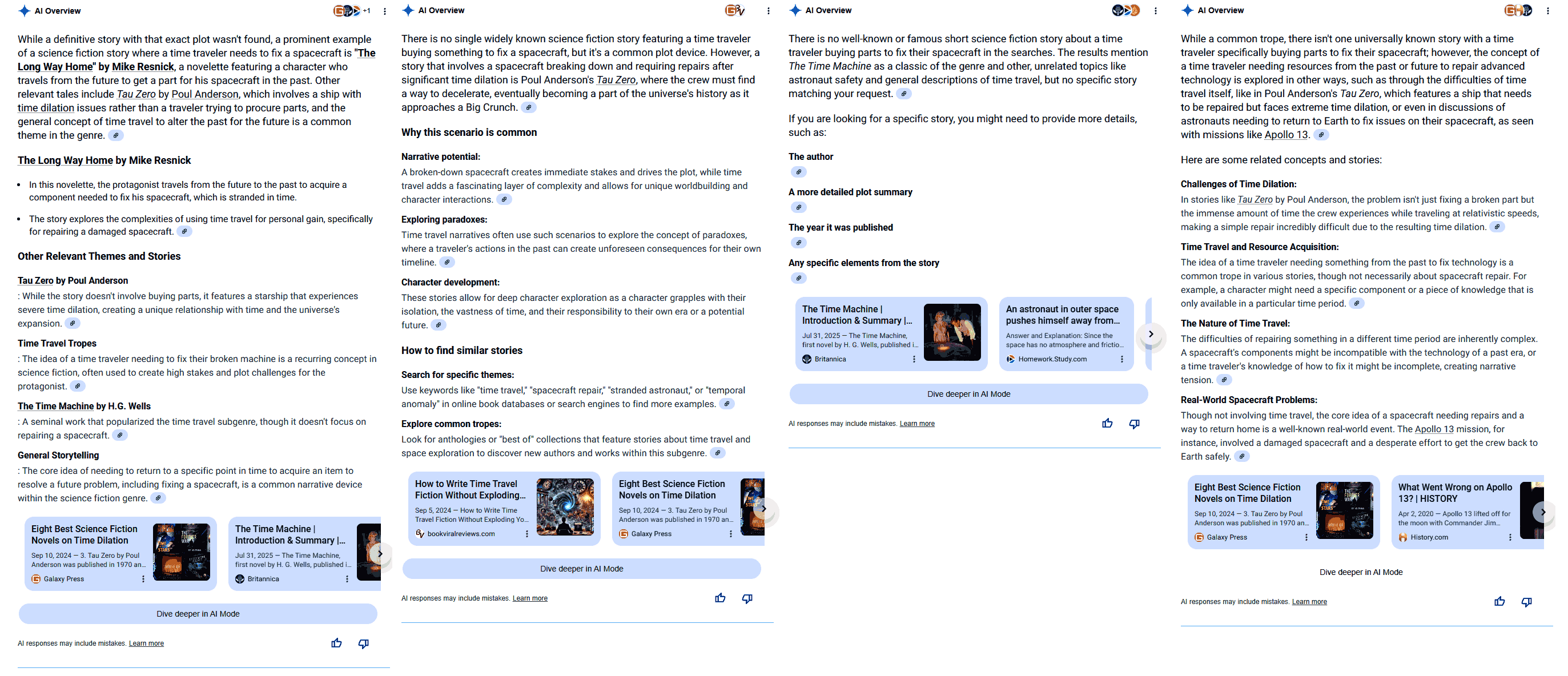
The first of these AIOs focuses on two stories: The Long Way Home (supposedly) by Mike Resnick and Tau Zero by Poul Anderson. Mike Resnick and Poul Anderson are indeed both SF authors and Tau Zero is a famous book that garnered Poul Anderson the 1971 Hugo for best novel. Google’s capsule summary of its story line is correct enough. But Mike Resnick has not written anything with the title The Long Way Home
. Poul Anderson did put out a novel with that title in 1975 and it was likely an edited version of the serialization published in Astounding SF over the course of several months in 1955. Anderson’s TLWH also concerns time dilation issues stemming from interstellar travel, so Google has funked up both the plot and the author of TLWH. Finally, Wells’s The Time Machine is mentioned in passing.
The second and third AIOs concern, respectively, Tau Zero and The Time Machine. The fourth cites Tau Zero and also tries to work the real-world Apollo 13 debacle into the mix.
To see how Google would react to probing for details of the fabricated Buy Me a Rocket
story a few days later, I ran a new search: when was Alfred Bester’s story ‘Buy Me a Rocket’ first published
. Here’s Google’s AI
response:
Alfred Bester’s story “Buy Me a Rocket” was published in the magazine Fantastic Universe in October 1958. The story is also known by its alternate title, “What Can You Do?” and can be found in Bester’s collection of short stories, The Dark Masquerade. To find the story, look for the October 1958 issue of Fantastic Universe or the The Dark Masquerade collection, which compiles some of Bester’s best short fiction.
Now, here’s an image showing the cover and table of contents of the October 1958 issue of Fantastic Universe:
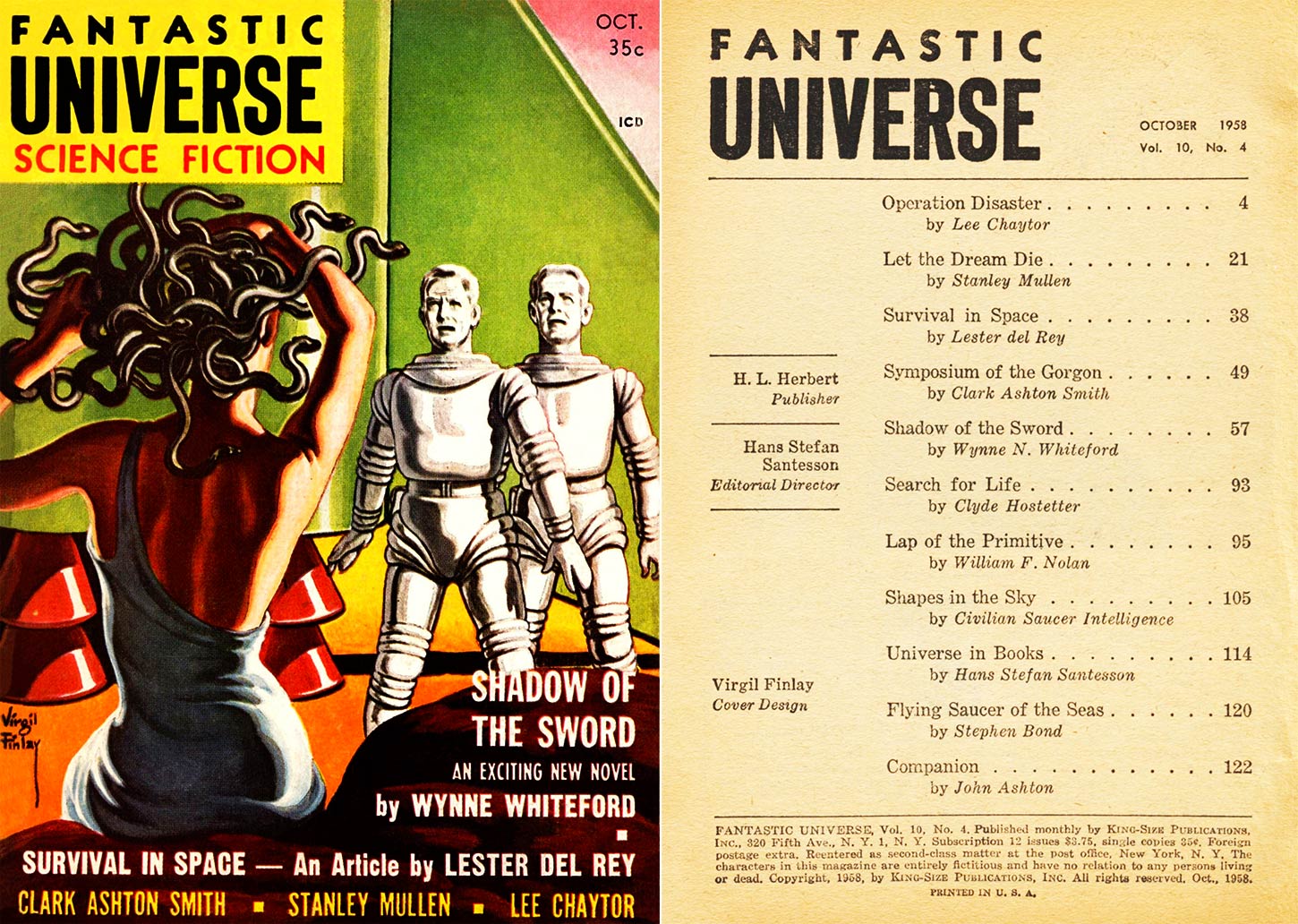
Do you see any story by Bester? Or anything with the title Buy Me a Rocket or What Can You Do? Nope, me neither. Likewise, there is Alfred Bester collection with the title The Dark Masquerade and he never published any story titled What Can You Do?.
At the bottom of their AI Overview
in smaller print is the following disclaimer: AI responses may include mistakes.
Yeah, no shit.
How many falsehoods are, at this very moment, being spun out of whole cloth and spread far and wide in this fashion by LLMs? At least until very recently, Google and other large companies of its ilk have been devoting considerable resources to fact-checking
and censoring content hosted on or even merely transmitted through their platforms on the pretext that it ran counter to selected experts’ opinions and alleged consensus views on various topics. Now, we are watching them deprecate actual content (search results in this case) in favor of generated slop which purports to address users’ needs and wants but which we’re beginning to learn is often wrong and sometimes completely blatantly bonkers. Odd, isn’t it?